


Security Updates
Like a computer or smartphone, a vehicle needs regular updates to close known and potential vulnerabilities.

the international standard for managing cybersecurity risk across a vehicle’s life cycle
India’s requirements for a Cyber Security Management System
India’s requirements for a Software Update Management System
the UN regulation on vehicle cybersecurity and cybersecurity management systems
the UN regulation on software updates and software update management systems
ATS Poland can support you with gap assessments, process and documentation readiness, and certification guidance, helping you meet these requirements and bring your vehicles to market with confidence. Contact Us to discuss your cybersecurity compliance needs.

As vehicles become more connected, the risk of cyberattacks grows with them. To respond, the United Nations Economic Commission for Europe (UNECE) introduced R155 and R156 under the 1958 Agreement. Together they require cybersecurity to be built into motor vehicles across their whole life cycle and throughout the supply chain.
Alongside these rules, ISO/SAE 21434 (Road Vehicles: Cybersecurity Engineering) was published in August 2021. It gives organisations a practical way to put the regulatory requirements into practice and, for the first time, gives manufacturers one consistent framework to work from. Because the audit reaches the entire supply chain, suppliers must meet these expectations too, not only vehicle makers.
TISAX® (Trusted Information Security Assessment Exchange) is an assessment and data-sharing mechanism for information security in the automotive sector, created by the German Association of the Automotive Industry (VDA). It is built on the VDA ISA catalogue, which itself draws on ISO/IEC 27001.
In practice, TISAX® is often a precondition for doing business with automotive partners, especially when sensitive information is exchanged. Its purpose is to avoid repeated audits and to establish a common security baseline across the industry.

| Item | Purpose |
|---|---|
| UNECE R155 | Cybersecurity and cybersecurity management systems |
| UNECE R156 | Software updates and software update management systems |
| ISO/SAE 21434 | Cybersecurity engineering across the vehicle life cycle |
| TISAX® | Information security assessment for the automotive supply chain |
Meeting these requirements can have far-reaching effects on a vehicle’s safety concept and its electrical/electronic (E/E) architecture. The goal is to apply the rules across the supply chain, make new vehicle generations more secure, and update outdated processes to match today’s threats. The following measures are recommended throughout the vehicle life cycle:
Like a computer or smartphone, a vehicle needs regular updates to close known and potential vulnerabilities.
Keeping critical functions separate from less critical ones limits how far an attack can spread.
Hardware-based firewalls or dedicated security chips can ensure that only signed, trusted software runs on the vehicle.
Regular testing by security specialists uncovers weaknesses in vehicle systems so they can be fixed before attackers find them.

01 · MARKET & GOVERNANCE
 Europe |  USA |  Japan |  China |  Korea |  UK |  India | |
|---|---|---|---|---|---|---|---|
| Automotive Cybersecurity Regulations | UNECE R 155/ 156 | Self Certification** | UNECE R 155/ 156 | GB 44495 - 2024 | UNECE R 155/ 156 | UNECE R 155/ 156 | AIS189/190 |
| New Models Target Date | July 2022 | NA | Jan 2024 | NA | July 2022 | July 2022 | Oct 2027 |
| All Models Target Date | July 2024 | NA | May 2026 | Jan 2026 | July 2024 | July 2024 | Oct 2028 |
| Data Privacy | GDPR | CCPA | Personal Information Protection | Jan 2026 | Personal Information Protection | GDPR | PDPB |
CSMS Process Definition
Full vehicle TARA
Vehicle level security requirements
Cybersecurity Implementation (Network+ Components Owned)
Cybersecurity Infrastructure & Integration(KMS)
Fuzz & Penetration Testing
Homologation
Vulnerability Management
07 · HOMOLOGATION & SUMS
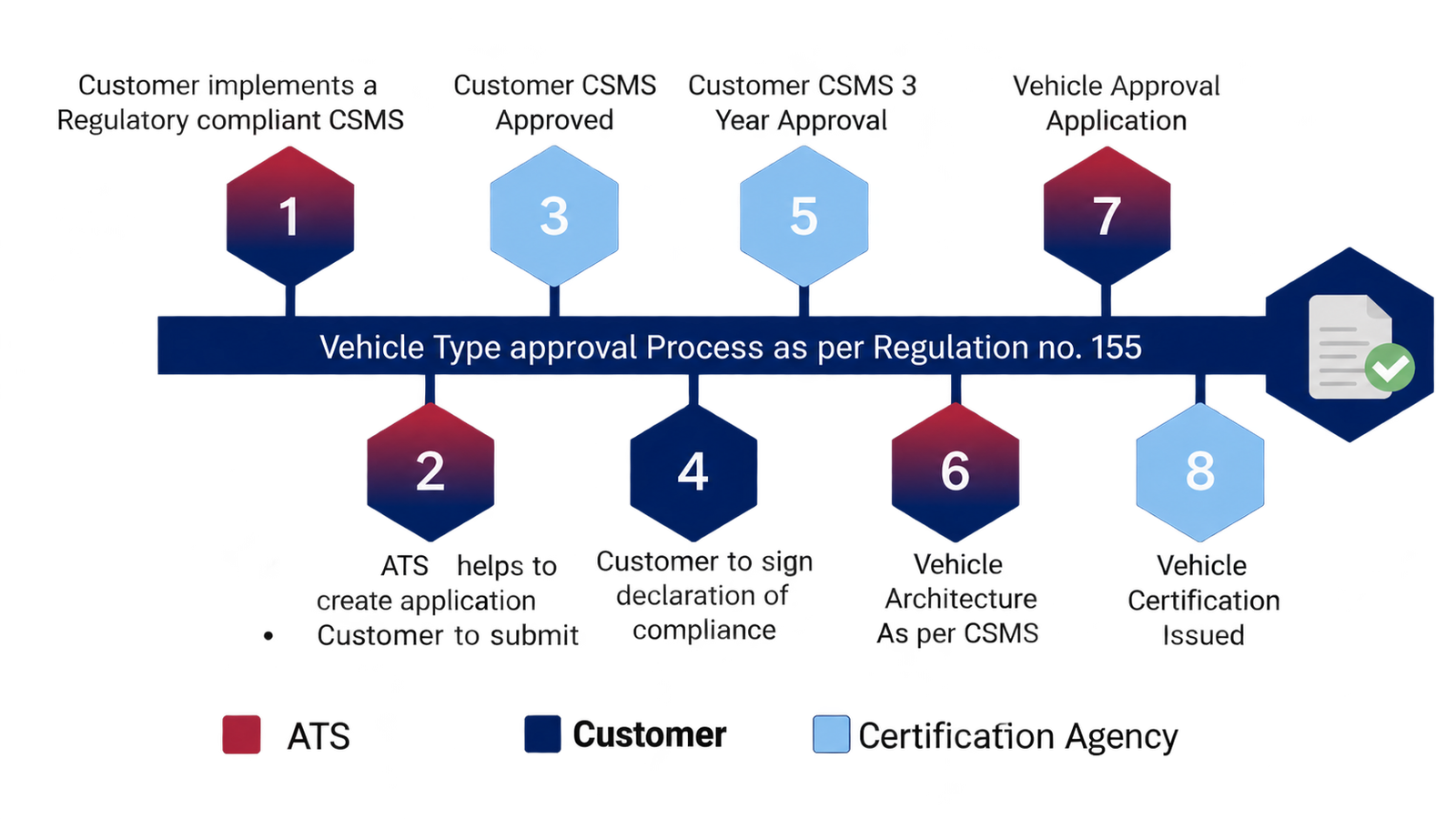
Following process shows ATS involvement in Homologation process.
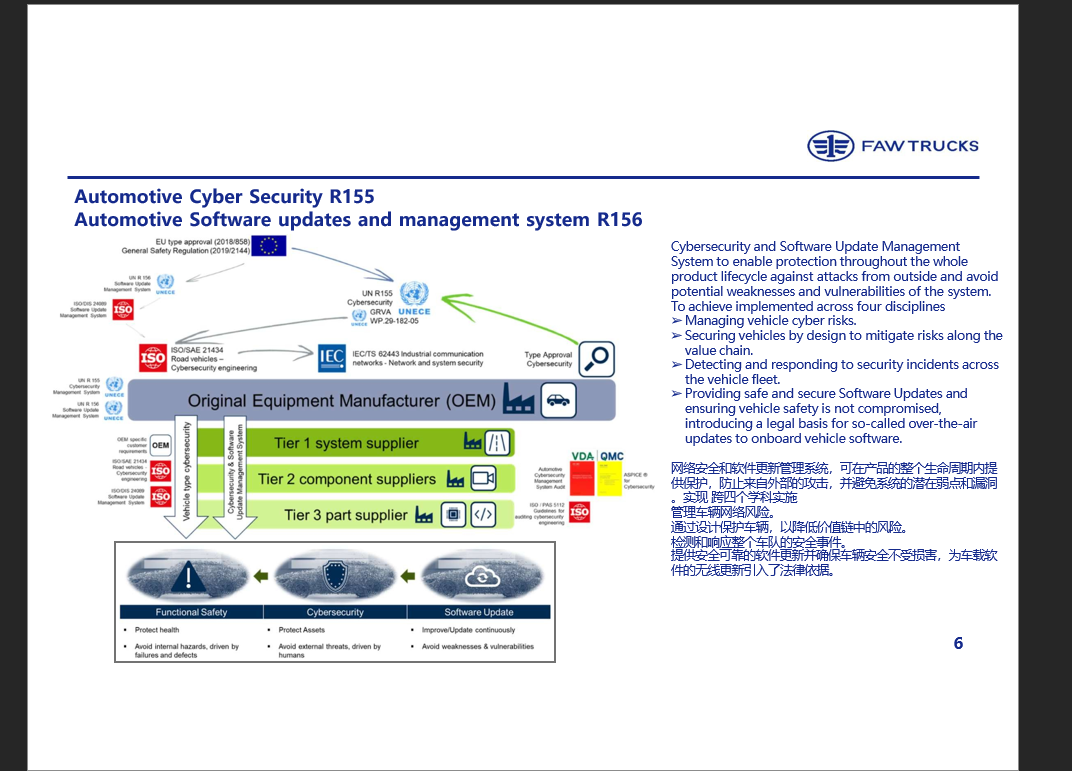
Cybersecurity and Software Update Management System to enable protection throughout the whole product lifecycle against attacks from outside and avoid potential weaknesses and vulnerabilities of the system.
To achieve this, implementation spans four disciplines:
ATS Poland supports manufacturers and suppliers with cybersecurity readiness, from gap assessments and documentation to testing and certification guidance. to discuss your compliance needs.